
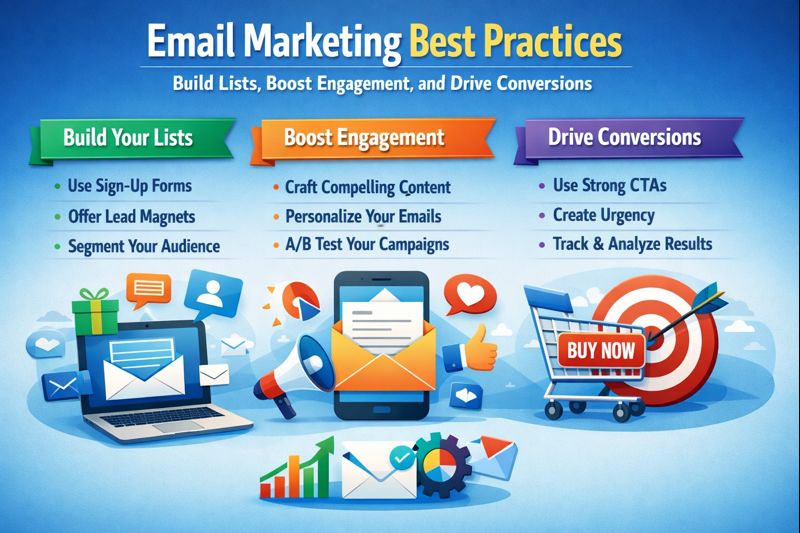
Analysis & Improvement Plan
Post Type: Informational + Commercial intent
Search Intent: Users want to learn proven email marketing strategies to grow their subscriber base, increase engagement, and convert leads into customers.
Key Improvements I’ll Focus On:
- Keyword optimization – Naturally weave “email marketing best practices” into the title, intro, and 3–5 headings without stuffing.
- Structure & readability – Break content into scannable H2/H3 sections with short paragraphs and bullet points.
- Length & depth – Expand to 900–1,000 words with actionable tips and real-world examples.
- Internal/external links – Suggest anchor text for WordPress-related internal links and authoritative external sources.
- FAQ section – Add user-focused questions to boost featured snippet chances and Rank Math score.
Email marketing remains one of the most powerful tools in your digital marketing arsenal. When done right, it delivers an average ROI of $36 for every $1 spent. But here’s the catch: building a quality email list, keeping subscribers engaged, and turning readers into customers requires following proven email marketing best practices.
In this guide, you’ll discover how to grow your subscriber base organically, craft emails people actually want to open, and drive measurable conversions—all without sounding like a pushy salesperson.
Why Email Marketing Still Matters in 2026
Social media algorithms change overnight. Search engine rankings fluctuate. But your email list? That’s an asset you own and control.
Unlike platforms where you’re “renting” an audience, email gives you direct access to people who’ve raised their hands and said, “Yes, I want to hear from you.” That makes it ideal for:
- Building genuine relationships with your audience
- Nurturing leads at their own pace
- Promoting products or services without competing for attention in crowded feeds
- Driving repeat purchases and long-term loyalty
Table of Contents
Now let’s dive into the strategies that separate successful email marketers from the rest.
Email Marketing Best Practices for Building High-Quality Lists
Your email list is only as valuable as the people on it. Here’s how to attract subscribers who genuinely care about your content.
1. Offer Irresistible Lead Magnets
Nobody hands over their email address for nothing. Give visitors a compelling reason to subscribe by offering:
- Free guides or eBooks that solve a specific problem
- Checklists and templates they can use immediately
- Exclusive discounts or early access to new products
- Mini-courses delivered via email over several days
Make sure your lead magnet aligns with what you’ll send in future emails. If someone signs up for a “Beginner’s Guide to WordPress,” don’t surprise them with sales pitches for unrelated services.
2. Place Opt-In Forms Strategically
The best lead magnet won’t work if people can’t find your signup form. Test these high-converting placements:
- Pop-ups (timed or exit-intent) that appear at the right moment
- Sidebar widgets visible on every page
- Inline forms embedded within blog posts
- Welcome mats that greet new visitors with a full-screen offer
Pro tip: Use WordPress plugins like OptinMonster or Thrive Leads to create and A/B test different form designs.
3. Keep Signup Forms Simple
Long forms kill conversions. For most businesses, asking for just an email address is enough to start. You can collect additional details later through preference centers or progressive profiling.
Always include a clear value proposition above the form: “Get weekly WordPress tips delivered to your inbox” works better than “Subscribe to our newsletter.”
Email Marketing Best Practices for Boosting Engagement
Getting subscribers is step one. Keeping them engaged is where the real work begins.
4. Segment Your Audience
Not all subscribers are alike. Some are brand new, others are repeat customers. Sending the same message to everyone is a missed opportunity.
Segment your list based on:
- Behavior (what they clicked, downloaded, or purchased)
- Demographics (location, job title, industry)
- Engagement level (active readers vs. inactive subscribers)
With segmentation, you can send personalized content that resonates with each group’s specific needs and interests.
5. Craft Compelling Subject Lines
Your subject line determines whether someone opens your email or sends it straight to trash. Follow these email marketing best practices for subject lines:
- Keep it under 50 characters so it displays fully on mobile
- Create curiosity without being clickbait-y
- Use numbers and power words (“5 Quick Wins,” “Exclusive Offer”)
- Test personalization (adding the subscriber’s name can boost opens)
Avoid spam triggers like ALL CAPS, excessive punctuation!!!, or phrases like “Act now” or “Free money.”
6. Write Emails That Sound Human
Nobody enjoys reading corporate jargon or robotic sales copy. Write like you’re talking to a friend:
- Use “you” and “I” language
- Ask questions and encourage replies
- Share stories and real examples
- Keep paragraphs short (2–3 sentences max)
Think of each email as a one-on-one conversation, not a broadcast announcement.
7. Optimize for Mobile Devices
Over 60% of emails are opened on smartphones. If your messages don’t look good on mobile, you’re losing engagement.
Make sure your emails feature:
- Responsive design that adapts to any screen size
- Large, tappable buttons for calls-to-action
- Short paragraphs and plenty of white space
- Readable fonts (at least 14px for body text)
Test every email on multiple devices before hitting send.
Email Marketing Best Practices for Driving Conversions
Engaged subscribers are great, but conversions pay the bills. Here’s how to turn readers into customers.
8. Include Clear Calls-to-Action (CTAs)
Every email should have one primary goal. Do you want subscribers to:
- Read a new blog post?
- Download a resource?
- Purchase a product?
- Register for a webinar?
Whatever it is, make your CTA impossible to miss. Use contrasting button colors, action-oriented text (“Get My Free Guide” beats “Click Here”), and place your CTA both mid-email and at the end.
9. Build Trust Before You Sell
Nobody likes being sold to constantly. Follow the 80/20 rule: 80% of your emails should provide value (tips, stories, useful content), and only 20% should be promotional.
This approach builds trust and positions you as a helpful resource rather than just another company trying to make a sale.
10. Use Automation to Nurture Leads
Email automation lets you deliver the right message at the right time without manual work. Set up automated sequences for:
- Welcome series that introduces new subscribers to your brand
- Educational drip campaigns that teach subscribers over time
- Abandoned cart reminders for eCommerce stores
- Re-engagement campaigns to win back inactive subscribers
Most email platforms (Mailchimp, ConvertKit, ActiveCampaign) offer easy-to-use automation builders.
11. A/B Test Everything
Guessing doesn’t scale. Testing does. Experiment with:
- Different subject lines
- Send times and days
- Email layouts
- CTA button colors and copy
Even small improvements in open rates or click-through rates compound over time into significant revenue gains.
Common Email Marketing Mistakes to Avoid
Even experienced marketers make these errors. Here’s what to watch out for:
- Buying email lists (it hurts deliverability and damages your reputation)
- Ignoring analytics (track open rates, click rates, and conversions to improve)
- Sending too frequently (respect your subscribers’ inboxes)
- Forgetting to clean your list (remove inactive subscribers regularly)
- Not optimizing for deliverability (use a reputable email service provider and authenticate your domain)
Frequently Asked Questions About Email Marketing Best Practices
How often should I send marketing emails?
There’s no one-size-fits-all answer, but most businesses find success with 1–2 emails per week. Test different frequencies and let your analytics guide you. If unsubscribe rates spike, you’re probably emailing too often.
What’s a good email open rate?
Average open rates vary by industry, but 20–25% is considered solid. Focus more on engagement (clicks and conversions) than vanity metrics like opens.
Can I use WordPress to manage my email marketing?
While WordPress itself doesn’t handle email sending, you can integrate it with email marketing platforms like Mailchimp, Sendinblue, or ConvertKit using plugins. This lets you capture leads directly from your WordPress site.
How do I reduce email unsubscribes?
Set clear expectations during signup, segment your list to send relevant content, and always provide value before asking for anything. An unsubscribe button should always be visible—hiding it frustrates people and hurts your sender reputation.
Final Thoughts: Put These Email Marketing Best Practices Into Action
Growing a profitable email list doesn’t happen overnight. It requires consistently applying these email marketing best practices: offering genuine value, respecting your subscribers’ time, and optimizing based on data.
Start with one or two strategies from this guide. Maybe it’s creating a better lead magnet or segmenting your list. Test, measure, and refine. Over time, these small improvements add up to a powerful marketing channel that drives real business results.
Ready to level up your email marketing? Start implementing these tactics today and watch your engagement and conversions soar in 2026 and beyond.
Top Email Platforms I Recommend
Affiliate disclosure: Some links below may earn us a commission at no extra cost to you. Full disclosure.
- Beehiiv — Free up to 2,500 subs, built-in monetisation & referral system.
- MailerLite — Free plan with automation included. Excellent deliverability.
- ConvertKit — Best for bloggers & creators who sell digital products.
- Systeme.io — Email + funnels + courses in one free platform.
Want your email marketing set up properly? At The Growth X Media, we build complete email automation systems for service businesses. → Book a free 20-min strategy call or get our Email Automation Playbook for ₹999.
Leave a Reply to Internet Marketing: A Complete Guide to Building Your Online Business Empire – thegrowthxmedia.com Cancel reply